How to Reduce Appointment No-Shows Without Making Every Client Prepay
A practical way to combine confirmations, reminders, deposits, and clear cancellation rules according to the real risk of each appointment.
On this page
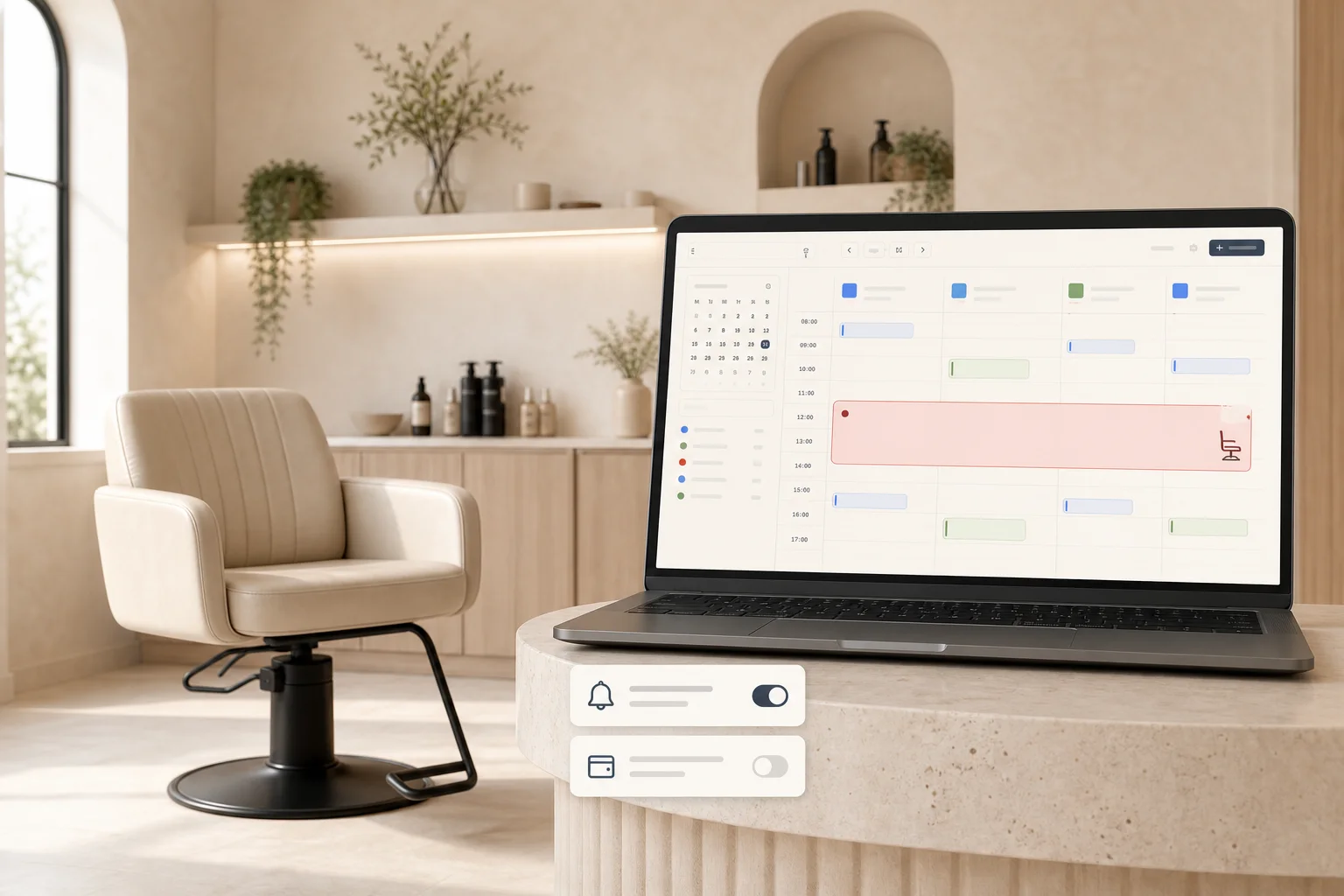
At 10:07, the chair is still empty.
The booking was for a three-hour color service. The specialist kept the morning clear. Another customer was turned away earlier in the week. Now the phone goes to voicemail, and those three hours cannot be put back on the shelf.
After this happens twice, full prepayment for every appointment can feel like the obvious answer.
It usually is not.
A quick haircut, a three-hour color service, and a yoga class with twelve places do not carry the same risk. Requiring the same payment rule for all three adds friction where it is not needed.
The better approach is to protect each booking according to what the business actually stands to lose.
A good no-show policy protects expensive, hard-to-refill bookings without making every other appointment harder to book.
A missed appointment costs more than the price on the service list
An appointment slot expires. Once Tuesday from 10:00 to 13:00 has passed, you cannot sell it later.
The visible loss is the unpaid service. But the loss goes beyond that:
- a specialist, room, chair, or device was reserved;
- another customer may have been refused that time;
- preparation may already have begun;
- the gap may be too awkward to fill with another service;
- staff still need to call, message, update the calendar, and decide what happens to any payment.
The arithmetic is uncomfortably concrete. A three-hour colour service at 90 euros does not cost you 90 euros when the client fails to arrive. It costs 90 euros, plus the client you turned away for that slot, plus the colour already mixed, plus three hours nobody is giving back. One missed appointment like that costs more than half a year of the software that was supposed to prevent it.
Not every missed visit creates all of these costs. That is precisely why one business-wide rule is rarely the best answer.
Start with the risk of the service, not your frustration with the client
It is tempting to write a policy immediately after a bad no-show. Wait until the emotion has cooled, then look at the booking itself.
For every important service, ask:
- How much time does it occupy? Losing three hours is different from losing twenty minutes.
- How easily can the time be resold? A Saturday afternoon slot may refill; a Tuesday morning gap tomorrow may not.
- Does it reserve a limited resource? Think beyond the specialist: a treatment room, court, chair, or device may be unavailable to everybody else.
- Does the team prepare in advance? Materials, room setup, travel, or specialist preparation increase the cost before the customer arrives.
- What happens if a place opens? A class with an active waitlist has a chance to fill the place that a one-to-one appointment may not have.
- How clear was the booking? A customer who never received a written confirmation is not the same operational problem as someone who ignored a reminder and a stated deposit policy.
Do this service by service. A simple table is enough.
| Booking type | What makes it risky | Lightest sensible starting rule |
|---|---|---|
| Haircut, manicure, brow shaping | Little time; often easier to refill | Written confirmation, optional reminder, pay on site |
| Colour, highlights, a peak-day slot | Several hours or scarce capacity | Confirmation and a fixed or percentage deposit |
| Keratin, nail extensions, restoration | High value, specialist preparation, difficult to replace | Larger deposit or full prepayment |
| Visit paid from an eligible package | The reserved capacity is still lost | Confirmation and reminder; explain that cancellation restores eligible redeemed credit, while a no-show does not restore it automatically |
| Group class with seats (yoga, training) | One cancellation can become an empty seat | Clear cancellation rule and an active waitlist |
These are starting points, not laws. A massage studio, tattoo artist, barber, and Pilates instructor will draw the lines in different places.
Use different levels of protection for different bookings
A useful policy has several levels. Start with the easiest rule that still protects the booking, then add more commitment only where the risk justifies it.
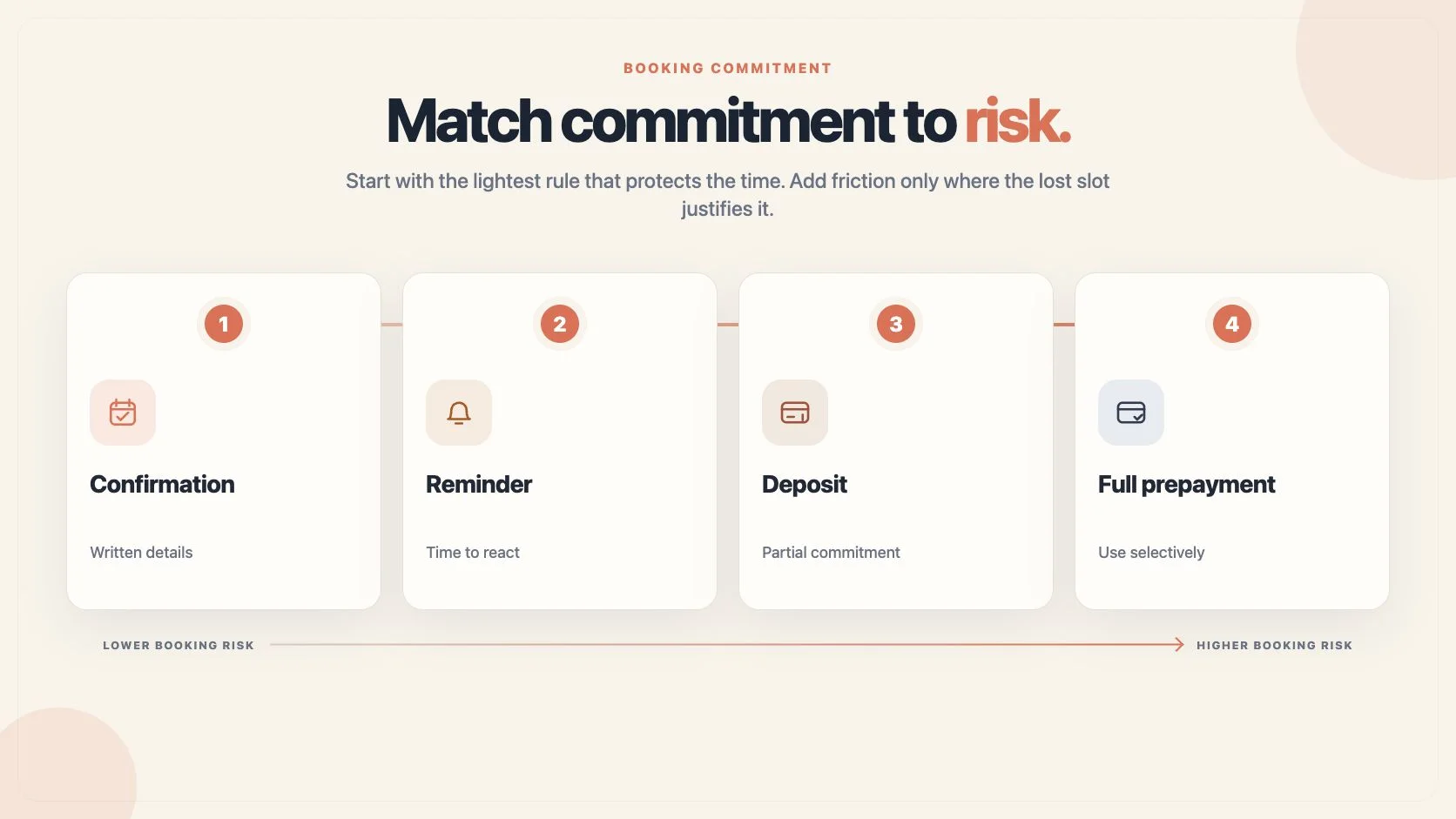
Level 1: Give the customer a written confirmation
A verbal “see you Thursday” is easy to misremember. A useful confirmation should make the booking identifiable and explain the next action. Mountify’s current public-booking email includes the business name, service, date and time, plus either a manage-booking or confirmation link.
If a business receives fake or routinely unconfirmed bookings, it can also use an optional confirmation window. The customer gets a limited time to confirm through the link; if they do not, the slot is released. This adds friction, so it should solve a real problem, not become a default ritual.
Level 2: Add a useful reminder
Not every no-show is deliberate. People forget, mix up the day, or remember too late. An email reminder is the simplest first step because it asks for no payment. In Mountify, customers booking online can choose a reminder one hour, two hours, or one day before the visit, provided they enter an email address. Manually added bookings do not use the same notification path.
The timing should leave the customer enough room to act and the business enough room to respond. A reminder five minutes before a three-hour appointment is little more than a notification of an already lost slot.
Level 3: Ask for a deposit
When a missed slot would be costly, a deposit is more appropriate than a reminder alone. Set it high enough to discourage a casual booking, but no higher than the risk justifies. Show the amount and refund terms before the customer confirms.
Common practice is 20% to 50% of the price, or a flat 10–30 euros. For services over three hours most salons sit at the upper end. Take a 90-euro service and a 30% deposit: a no-show leaves you holding 27 euros against a 90-euro loss. That is not compensation — it is a filter. Judge the deposit by whether no-shows fall, not by how much you collect when they do not.
The deposit is taken through your own Stripe account: the money goes straight to you, and Mountify takes no percentage of the booking. That is also why the deposit belongs in the booking system rather than in a separate reminder tool — it attaches to a specific service, is taken at the moment of booking, and shows up in the payment status afterwards.
In Mountify, each service has its own deposit or prepayment rule; online deposits require a connected payment provider. A deposit reduces casual no-shows, but it cannot guarantee attendance.
Deposits are set per service. Switch one on only for the appointments you cannot afford to lose — it takes about ten minutes and changes nothing about the rest of your menu.
Level 4: Use full prepayment selectively
Full prepayment creates the strongest commitment and the most friction. It is reasonable in three cases: the service needs material bought or mixed in advance; the appointment occupies a specialist for half a day; or the slot is in such demand that turning someone away has a cost of its own.
There is a cost on the other side, and it is worth saying plainly. Some clients abandon at the payment screen — especially new ones who do not know you yet. So full prepayment works best where the client has already decided: packages, courses, events with a published programme. For a standard salon service it usually costs more bookings than it saves.
A practical test: if you cannot name the specific expense you incur before the client arrives, you probably want a deposit rather than full prepayment.
Why we chose deposits over card-on-file
The large international platforms offer a different answer: the client leaves a card at booking and you charge it only on a late cancellation or a no-show. It is established practice in several markets, and it is a legitimate choice. We went the other way, for two reasons worth weighing before you copy either of us.
First, a charge the client did not consciously agree to at that moment is a leading cause of chargebacks — and how defensible the clause is depends on where you operate. In some markets, Bulgaria among them, consumer-protection rules treat a unilateral charge under a pre-agreed clause as difficult to enforce, so check the position in yours before relying on it. Second, willingness to leave a card on file varies widely by country; where it is unfamiliar, it costs you bookings at the payment screen rather than protecting them.
A small, visible deposit the client pays deliberately is easier to explain and easier to defend in more places.
Classes and packages are a separate case
Put the three examples side by side and the difference becomes clearer.
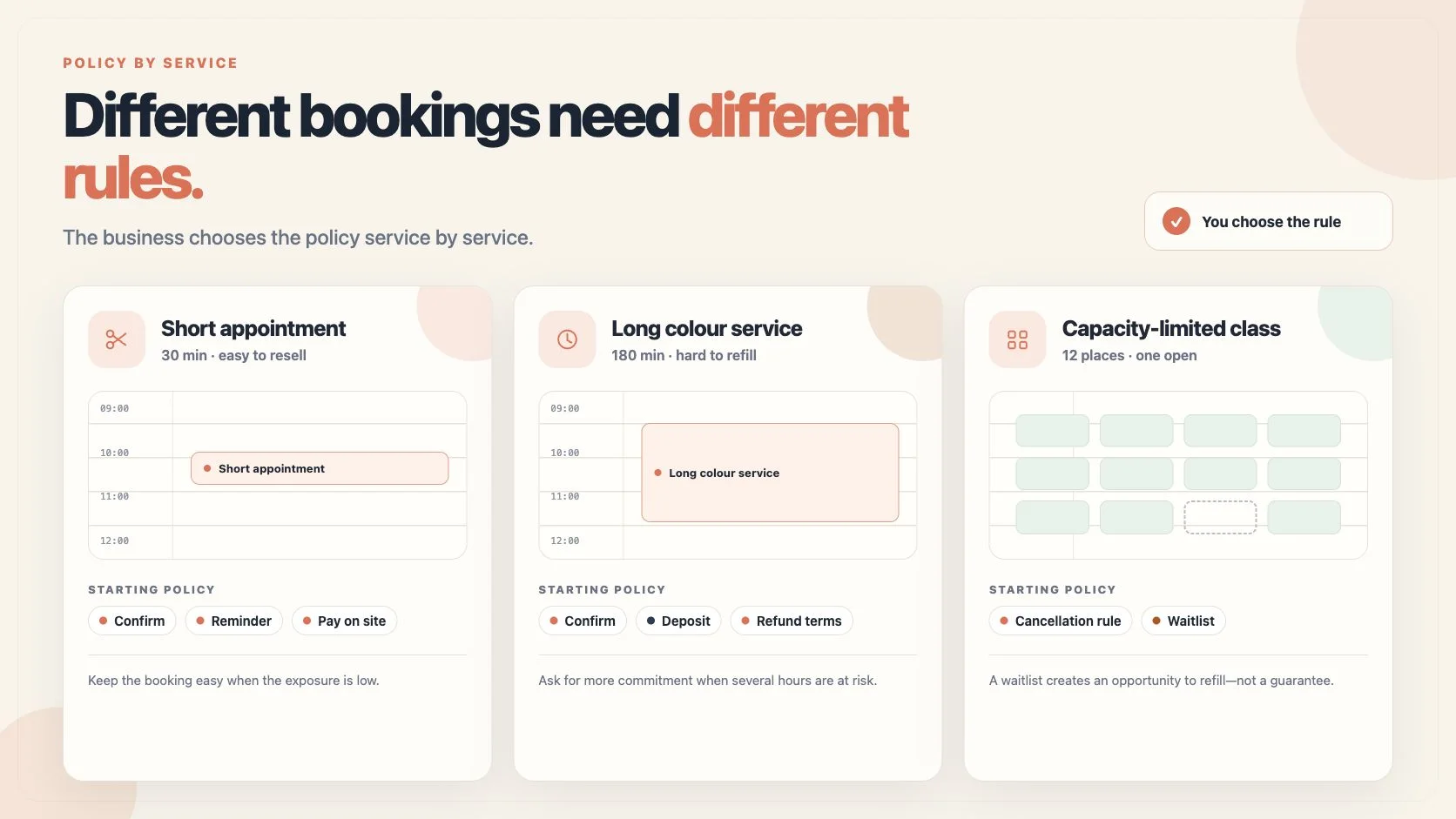
A haircut or a beard trim needs only confirmation and a reminder. Colour, highlights, keratin or nail extensions — where the product is already open and the chair is occupied for three hours — is where a deposit is the difference between a lost hour and a lost day.
Classes work differently, which is why they deserve their own note. A customer may use package credit instead of paying at checkout, but an empty place is still lost capacity. Explain how cancellation and no-show affect the credit.
Mountify supports fixed class capacity and a waitlist. When a seat opens, the oldest waitlisted booking is promoted automatically; on payment-gated boards that goes through staff so the payment condition is not bypassed. A waitlist is a chance to refill the place, not a guarantee — so check the result.
Write a refund policy your team can actually follow
“Refundable until 24 hours before the appointment” sounds clear. On a busy day, the team still needs to know who checks the deadline, who approves the refund, and where the action is recorded.
In Mountify, the refund option attached to a service is a promise shown to the customer. The setting does not issue a refund or enforce the cutoff automatically when the booking is canceled. An authorized staff member applies the policy and processes any refund that is due through the payment workflow.
Write the customer policy in one sentence, then document the staff procedure behind it. Do not promise an automatic refund if the team still has to process it manually.
Record what happened, or the policy cannot improve
A calendar full of old “confirmed” appointments cannot tell you whether people attended.
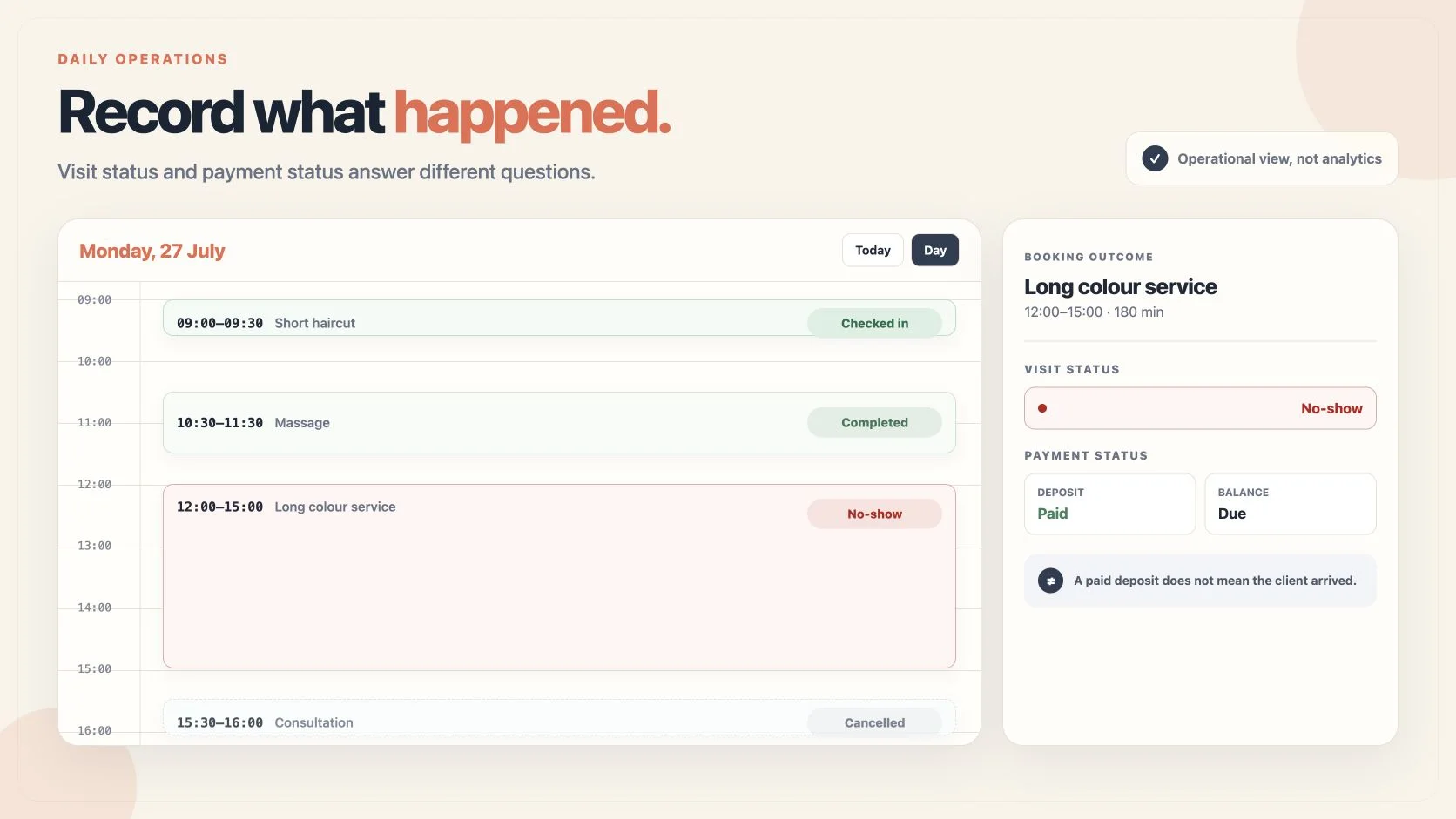
Each of these is marked on the booking itself — see check-in and no-show.
The daily routine should distinguish:
- arrived;
- completed;
- canceled by the customer;
- canceled by the business;
- no-show;
- unpaid, partially paid, and paid.
Visit status and payment status answer different questions. A customer can attend and still owe a balance. They can fail to attend after paying a deposit. They can cancel in time and be due a refund.
Mountify keeps these states separate through booking statuses and payment records. The useful part comes from staff consistency: if one person marks a missed visit as canceled, another leaves it confirmed, and a third marks it completed, the business is measuring data-entry habits rather than no-shows.
Mountify also updates past bookings that have no recorded outcome. By default, a confirmed booking becomes Completed after 24 hours. If automatic completion is disabled, it can instead become No-show after the configured grace period. Teams that need reliable data should record outcomes promptly and choose this setting deliberately.
Use the booking list and client history to review patterns manually by service and period; Mountify does not currently provide a dedicated no-show-by-service report.
- Which services are missed most often?
- Which lost slots are most expensive or hardest to replace?
- Did reminders solve enough of the problem?
- Did a deposit improve commitment without creating support disputes?
- Are cancellations arriving early enough to reuse the time?
You do not need an impressive dashboard to begin. Even a small sample is useful when everyone records outcomes consistently.
No-show rules in 20 minutes
Do this with the person who handles the calendar most often.
- Choose the three bookings you can least afford to lose. Start with real examples from the last month.
- Write down what each one consumes. Time, specialist, room, equipment, preparation, and peak capacity.
- Choose the easiest rule that still protects the slot. Confirmation, reminder, deposit, full prepayment, or package credit.
- Write the customer-facing rule in one sentence. Remove legal theatre and internal terminology.
- Write the staff action beside it. Who changes the status, handles a cancellation, and issues any refund?
That is the twenty minutes. Two things are left that do not fit one sitting: walk the whole journey on a phone — book, read the confirmation, look at the payment screen, cancel, and check what the team sees; and review the policy after a month of clean statuses, tightening only where the data justifies it.
If you do not have a system yet, run that check in a trial account — 14 days free, no card.
Three ready-made policies — take them as they are
Short appointment: “Your slot is reserved. If you cannot make it, message us at least 2 hours ahead so we can offer it to someone else.”
Long service: “For colour over 2 hours we take a 25 € deposit. It comes off your bill. We refund it for cancellations up to 24 hours before; later than that, or a no-show, we do not.”
Class: “Your place is held until 12 hours before the start. After that, cancelling does not return the package credit.”
Copy one of the three, change the amount and the deadline, and put it where the client sees it before confirming.
Do not start by rewriting the policy for every service. Start with the costly exceptions. Different rules for different services are easier for customers to accept and easier for staff to explain.
The client who never turns up is a separate question. A per-service rule is not a tool against one person — for that there is banning and archiving: a banned client can no longer book online, and their history stays. The softer step is to require a deposit from them even on the services where nobody else pays up front.
How to set these rules in Mountify
For each service separately you choose pay on site, a deposit — fixed or percentage — or full prepayment. Booking status and payment status are kept apart, so “did they turn up” and “have they paid” never get confused. Each client’s booking, cancellation and no-show history stays with them.
Two things go through a person on purpose rather than automatically: refunding a deposit — the money is in your Stripe account, so the call is yours; and judging an individual client — the system does not label anyone or raise their deposit by itself.
Different rules for different services are easier for customers to accept and easier for staff to explain. That is the whole idea of this article.
If you are still choosing the wider system around the policy, read what actually matters in salon booking software or see how we compare with Studio24 and Fresha. If the policy is already clear, the next job is making sure the customer sees it inside a trustworthy booking journey.
Frequently asked questions
How much deposit should I take for colour or keratin?
Common practice is 20% to 50% of the price, or a flat 10–30 euros. For services over three hours most salons sit at the upper end. Pick the smallest amount that creates a real commitment, and judge it by whether no-shows fall.
How do I take a deposit only on the long services?
Every service carries its own deposit or prepayment rule, so you can switch it on for colour and keratin without touching your cuts. It takes about ten minutes to set up, and the amount is shown to the client before they confirm.
Should every appointment require a deposit?
For a short appointment that refills easily, a clear confirmation and a reminder are usually enough. A deposit earns its friction on long, premium, peak-time or preparation-heavy services whose time is hard to resell.
Are reminders enough against no-shows?
Reminders recover the visits that would simply have been forgotten — and that is a large share of them. The remaining reasons need the next step: a deposit or prepayment. That is why a reminder is the first level of protection rather than the only one.
Who issues the refund if a client cancels?
You do. The money sits in your own Stripe account, so a refund goes through a person on your team applying the policy you published — by design, not automatically.
Start with the three appointments your business can least afford to lose. Give each one the right confirmation, reminder and deposit in Mountify, then test the journey as a customer. The money lands in your own Stripe account — Mountify takes no percentage of the booking.
Start for free → · 14 days, no card · How to set up a deposit · Compared with Studio24 and Fresha